Introduction
For years, Kenyan universities and colleges made do with LMS platforms borrowed from elsewhere — either heavyweight open-source systems that demand a full IT team, or lightweight course tools never meant to run an institution. In 2026, more institutions are switching to a purpose-built LMS. Here is why that shift is happening, and what actually changes when your platform is designed for how you operate.
The Generic-LMS Problem
A generic LMS looks fine in a demo and then quietly taxes your institution every single term. The most common pain points we hear from registrars and deans:
Generic platforms think in flat 'courses'. A Kenyan institution runs on faculties, departments, programmes, semesters and sessions. When your LMS can't model that, reporting and ownership become a constant workaround.
Self-hosted platforms mean your team babysits servers, security patches and version upgrades. Every crash during exam week becomes your emergency — not the vendor's.
Most LMSs have no concept of fee status. Institutions end up manually locking and unlocking learners, or letting unpaid students sit exams by mistake.
Without early-warning analytics, disengaged learners stay invisible until results day — when retention interventions are already too late to help.
What Changes With a Purpose-Built LMS
A purpose-built platform like Msingi LMS flips each of those problems into a strength:
- Native institution structure: faculties, departments, programmes, semesters and sessions are first-class, so reporting matches reality.
- Fully managed SaaS: TechSphere runs the servers, security, updates and backups — you don't need an IT team.
- Fee-status access control: mark each enrolment Paid, Partial or Pending to control study and exam access — without processing payments.
- Early-warning analytics: spot inactivity, overdue work and slipping performance in time to intervene.
The goal isn't more features. It's a platform that mirrors how your institution actually works — and that someone else keeps running around the clock.
Switching Without the Pain (or the Lock-In)
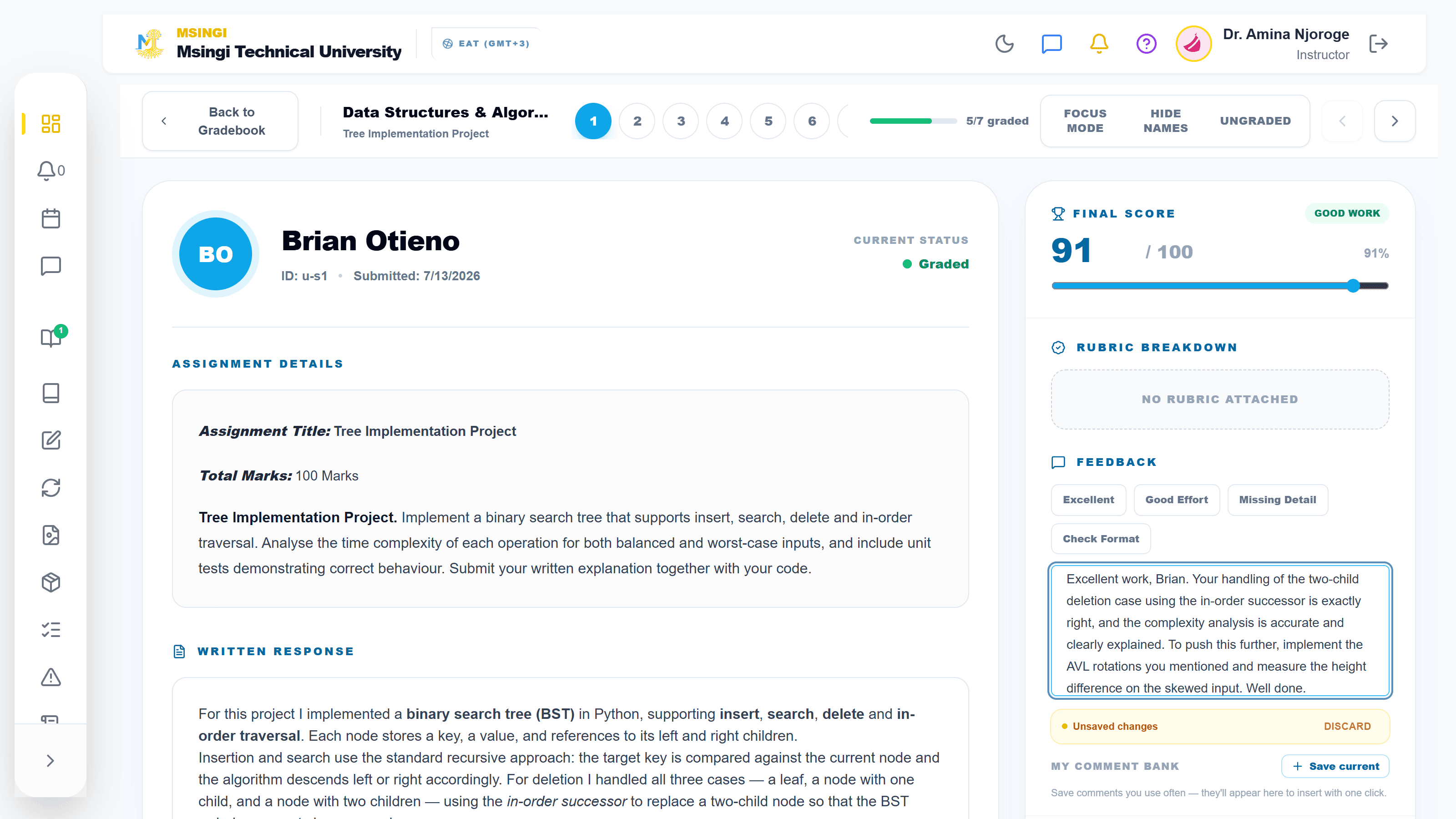
The biggest fear about switching is losing your content or getting trapped. Msingi is built to remove both risks. It imports SCORM 1.2/2004, xAPI and cmi5 packages, connects to your existing tools via LTI 1.3 with grade passback, and exports any Msingi course as a standards-compliant package — so your content is always portable. Early institutions also join as Founding Partners with sponsored setup, onboarding and introductory training, which makes the transition far smoother.
Conclusion
Kenyan universities and colleges are switching to purpose-built platforms because the hidden cost of "making do" adds up every term. If your current LMS fights your structure, drains your IT capacity, or leaves you blind to at-risk students, it may be time to move. Msingi LMS — built, managed and maintained by TechSphere — is designed to be the platform you don't have to fight.
See What Purpose-Built Feels Like
Book a demo and we'll show you Msingi mapped to your faculties, programmes and grading workflow.